
Our Mission: Social Prescription
What is Social Prescription?
Social prescription is a framework for "prescribing" access to care that goes beyond medicine. Food, fitness and nutrition, housing, employment services, legal aid, sexual violence supports, cultural programs, mental health resources, academic counselling and translation services are all examples of "social prescriptions".
Who is a care provider?
A care provider is anyone offering frontline support to service users. This can include doctors, nurses and other healthcare workers, social workers, academic advisors, student care teams, college staff, therapists, resettlement officers, sexual violence support staff, housing and shelter workers, human rights professionals and many more.
In short, any professional working in a frontline capacity to support people in need is a care provider.
Why do we need it?
Many of the challenges people bring to care providers aren’t just medical. Needs overlap, and too often the root cause that brings service users to care providers goes unaddressed.
Care providers are often siloed and disconnected within the larger and disjointed care infrastructure. There is little collaboration across professions even though the most vulnerable care recipients are also the most likely to use multiple frontline services. In the current landscape, there is little capacity for care providers to effectively refer to one another, communicate or collaborate. Social prescription bridges both of these gaps. It helps care providers share information, connect clients to the right supports the first time, and address underlying challenges faced by service users. This leads to stronger, long-lasting outcomes for service users, and less work for care providers.
Impact
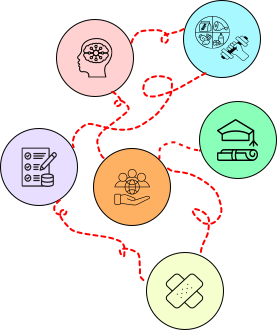
Social prescription ties all aspects of care together into a unified system. People receive more meaningful support that actually improves their lives, while providers across sectors can work more efficiently without duplicating labour or wasting resources by sending service users to the wrong provider. The result is a system that delivers better outcomes for individuals and communities, and greater sustainability for the broader care sector.
So...why don't we use it already?
There are two universal problems affecting nearly every aspect of the broader care sector. The first is the Administrative Burden. Care sector employees often spend more time on paperwork than on people, leaving little capacity to engage in holistic care. For example, doctors in North America spend ~15 minutes per patient interaction, but can spend up to an hour filling out federal forms. This is barely enough time to manage medical concerns, let alone social ones. A similar pattern unfolds across other sectors: minimal time with clients, massive amounts of time on paperwork, and all the while facing longer and longer waitlists and backlogs for their services.
The second is Lack of Infrastructure. Health, education, housing, justice, and social services all operate in isolation, with little awareness of or connection to one another. Without a platform to connect care providers, social prescription cannot be efficiently administered.
Shared Barriers
That's why we're building Bettering
The ultimate AI-powered social prescription platform for care providers
